
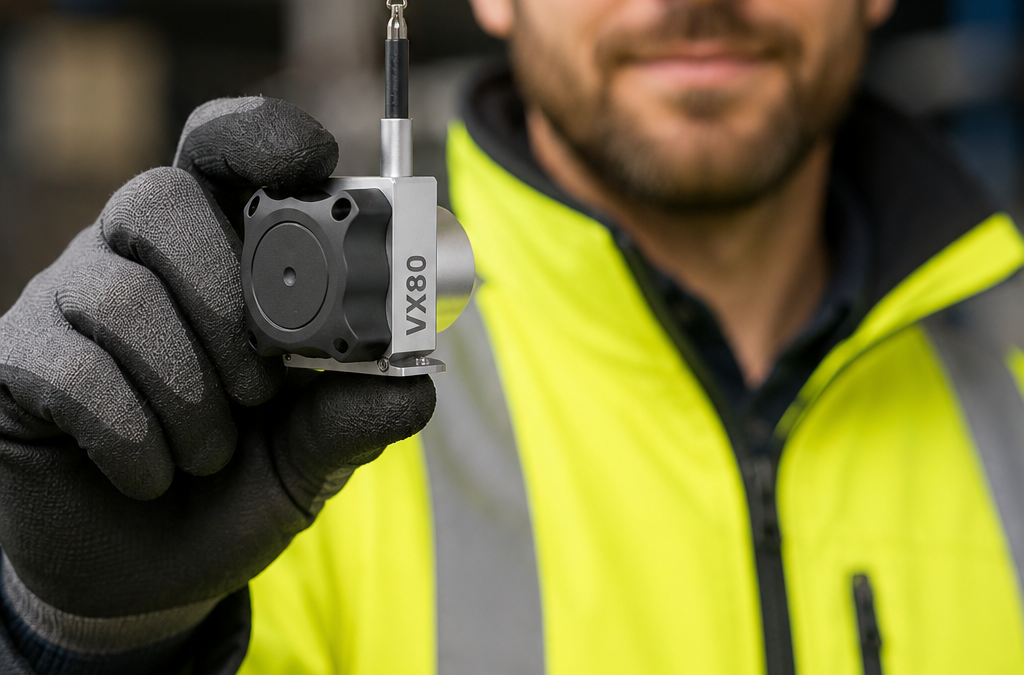
Construction machinery rarely stays still. Booms rise, arms extend, platforms move, and hydraulic cylinders constantly change position. For operators and engineers, knowing exactly how far a component has moved can make a real difference to safety, control and machine performance. This is where a draw wire encoder can provide a practical way to monitor linear movement, particularly where space is limited or conventional measurement methods are difficult to install.
What does a draw wire encoder actually measure?
A draw wire encoder measures linear movement by using a thin wire connected to the moving component. As the component moves, the wire extends or retracts. The sensor converts this movement into a position measurement that can be sent to the machine’s control system.
The principle is simple, which is part of its appeal.
Instead of requiring a long rigid measuring device along the entire movement path, the sensor can be mounted in a relatively compact location. This makes it useful for machinery where components move over considerable distances or where installation space around the mechanism is restricted.
Where could they help with construction machinery?
Think about a hydraulic excavator. Its boom and arm move through different positions while the machine is operating. Similar movement occurs in lifting equipment, access platforms and other mobile machinery.
A draw wire system can be positioned to track the movement of a suitable component and provide continuous information about its changing position.
There are several potential benefits:
Position monitoring: Movement can be measured continuously rather than estimated.
Control support: Position information can be fed into a machine’s control system.
Space-saving installation: Compact designs can suit areas where installation space is restricted.
Movement tracking: Engineers can monitor changes in position during testing or operation.
System integration: Different output options allow sensors to connect with control equipment and data acquisition systems.
What should you consider before choosing one?
The measurement distance is an obvious starting point, but it should not be the only consideration. The environment around the sensor matters too.
Construction machinery can be exposed to vibration, dirt, moisture and repeated movement. A sensor needs to suit those conditions rather than simply provide the required measurement range. Heavy-duty versions, for example, are designed for demanding environments and can offer greater protection against contamination and vibration.
The required output is another important factor. Some applications may need a voltage or current signal, while others may be better suited to an incremental encoder or SSI output. Compatibility with the existing control or data collection system should therefore be considered before installation.
Could draw wire encoders make machinery monitoring more reliable?
When machinery contains several moving parts, having dependable position information can make it easier to understand what is happening during operation. It can support automated control, testing and condition monitoring while giving engineers clearer data about movement.
The right choice depends on the machine, the distance being measured and the environment in which the sensor will operate. For anyone comparing options, speaking to a draw wire encoder supplier in the UK can help clarify which measurement range, output and construction are appropriate for the application.
At Sensors UK, we provide draw wire solutions designed for accurate linear position and displacement measurement, including applications where direct access to moving parts is limited. We offer measurement ranges from 50 mm to 50 m, with analogue and digital outputs such as voltage, current, SSI and incremental encoder options to suit different systems.
Need a clearer view of every movement? Speak to us now.
