
Modern industrial systems depend on knowing exactly where things are. In applications where a small measurement error affects productivity or damages equipment, accurate position feedback is not optional. String potentiometers give engineers a dependable way to measure linear displacement with high accuracy and repeatability, in real time.
How they deliver reliable measurement
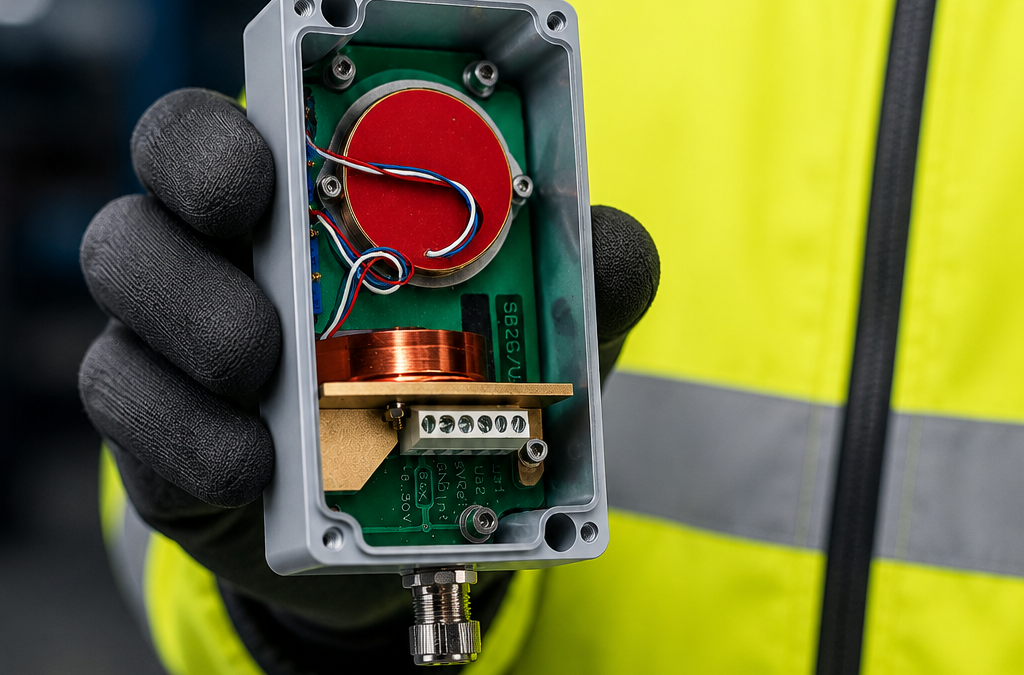
A string potentiometer pairs a flexible steel cable with an internal spool and sensing element. As the cable extends and retracts with the moving part, the rotation of the spool is converted into an electrical signal proportional to position. An internal torsion spring keeps the cable at constant tension, preventing slack as the machinery moves and keeping the reading true.
Where precision matters most
Actuators, robotic arms, presses and lifting equipment all move continuously, and their control systems need precise position feedback to function. Without it, movement cannot be controlled accurately, efficiency drops and the risk of equipment damage rises. String potentiometers supply that feedback across long travel distances where other sensing technologies struggle or become expensive.
Why engineers keep specifying them
They are compact relative to their measurement range, straightforward to mount and align, tolerant of harsh industrial environments, and available with analogue or digital outputs to suit almost any control system. For long-stroke linear measurement, few technologies match them on reliability per pound.
Choosing the right unit
The right specification depends on measurement range, required accuracy, output type and operating environment. A unit matched closely to the application delivers better signal stability than one that is over- or under-ranged.
Sensors UK supplies precision string potentiometers across the UK, with technical guidance to match the right sensor to your application. Contact the team at sales@sensorsuk.com or 01727 859373.
